Art | Crime Archive — maintaining an inherited live service
I maintain an inherited WordPress archive for its nontechnical owner, combining technical investigation, sandbox rehearsal, explanations of tradeoffs, and approved production changes. The work ranges from repairing article submission to correcting legacy attribution and investigating reliability problems. Each change has to serve the existing site and the person responsible for running it.
My role: maintenance investigation, change planning, owner communication, and production work, using AI-assisted analysis and tooling. The site belongs to its owner; production changes follow the agreed scope rather than my authority over a personal test environment.
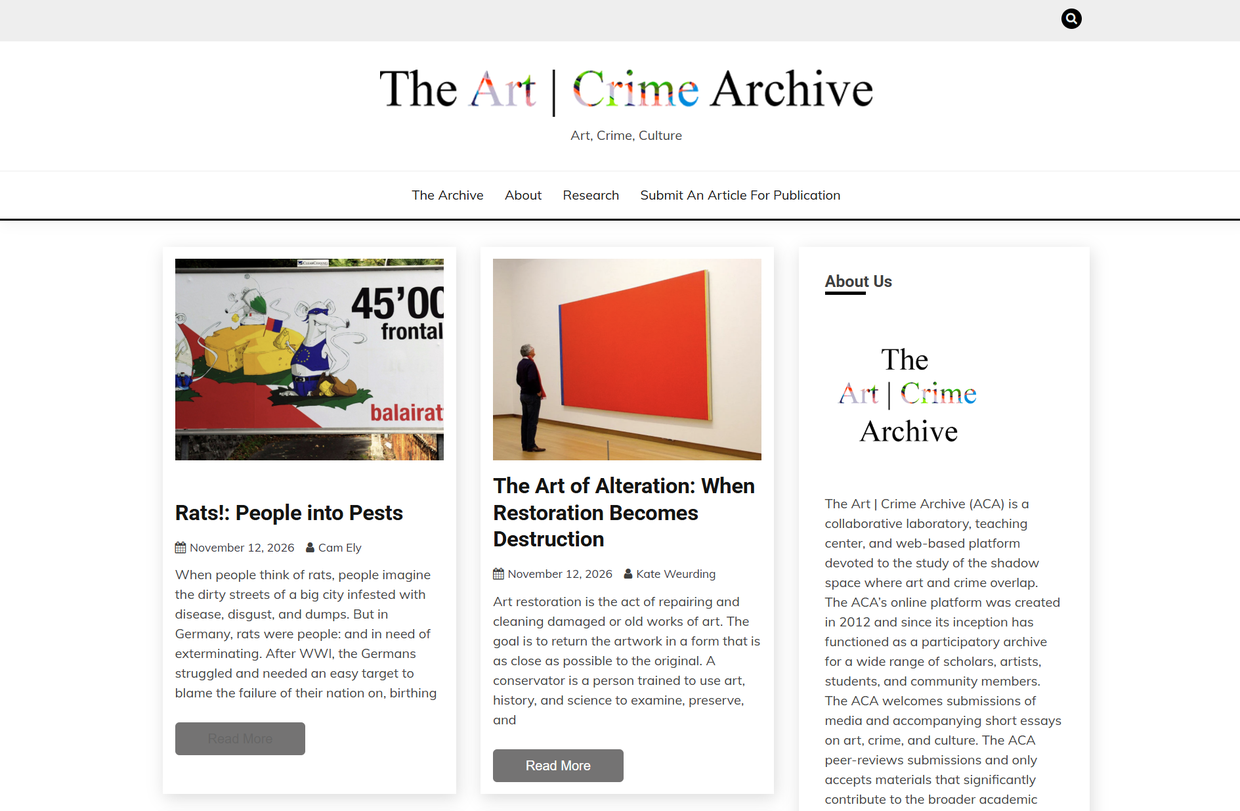
Repairing attribution without rewriting history
A migration had left older articles displaying incorrect attribution. The visible byline did not simply reflect the WordPress author field, so changing an account assignment would not by itself solve the presentation problem.
The repair began by reconstructing the affected set and separating posts that already carried the right credit from those requiring a change. Exceptions were agreed with the owner. Restore records and a small canary change preceded the scoped production update.
The result was 613 posts corrected to an archived-user byline, with 308 already-credited posts preserved. This was a correction of misleading displayed attribution, not recovery of missing original author identities. Database verification covered all 1,226 backed-up metadata rows and checked that excluded records were unchanged.
Investigating reliability across application and hosting boundaries
Production-log analysis identified process-slot exhaustion behind the observed 503 responses, which made caching the lever most likely to help. I rehearsed the settings changes in a restored sandbox first, rather than assuming the plugin behaved the way its interface suggested, and proposed reversible changes on that basis.
After approval, the cache changes shipped to production. Subsequent observations supported longer cache retention and reuse across tracking parameters.
A separate change blocked a high-volume Sogou crawler at the .htaccess level, approved by the owner on the hosting provider’s recommendation. I recorded the effect I expected before exporting eight days of logs to check it. The block worked — 4,286 crawler requests before, none after — but the logs also showed that this crawler had not been the source of the 503 responses, which tracked uncached dynamic page loads instead.
Other shipped maintenance included restoring the article-submission form through a shortcode after the page-builder widget failed to display it correctly.
Taking an exposure finding through remediation
The investigation also found publicly reachable backup artifacts containing database material. I documented and reported the exposure, distinguishing reachable files from evidence of intrusion.
Approved remediation removed the archives from the public web root and included credential-remediation work. The probed archive path subsequently returned 404. Temporary backup-file placement was part of the mechanism under review; removing the exposed files did not, by itself, prove future backup safety or complete resolution of every incident follow-up.
Maintaining the owner’s workflow, not just public pages
Later plugin cleanup was rehearsed in the sandbox, with before-and-after page captures and checks that existing form entries remained. Public pages continuing to render was not enough to establish that the owner’s editing, login, or submission workflows still worked, so the rehearsal was kept distinct from a completed production cleanup.
A form-replacement proof of concept also brought the owner’s requirements into the technical choice. Upload access, email delivery, ownership, embedding, and maintenance burden mattered alongside subscription cost. Testing and feedback reopened the choice rather than establishing a shipped replacement.
The ongoing work is to improve the inherited service without obscuring what changed, what was checked, and what still needs an owner decision or another test.