Private cloud platform, built as code
I designed and built a Proxmox private cloud with Terraform and Ansible to run internal services and support projects that need real infrastructure. The platform brings together compute, certificate management, DNS, artifact distribution, and telemetry. A cold-start rebuild campaign tested whether those services could be recreated from their dependencies—not just kept working after a successful installation.
My role: platform design, deployment planning, troubleshooting, and direction and review of AI-assisted implementation and operations. This was not an independently hand-coded build; AI agents also executed deployment and verification work within a human-reviewed workflow.
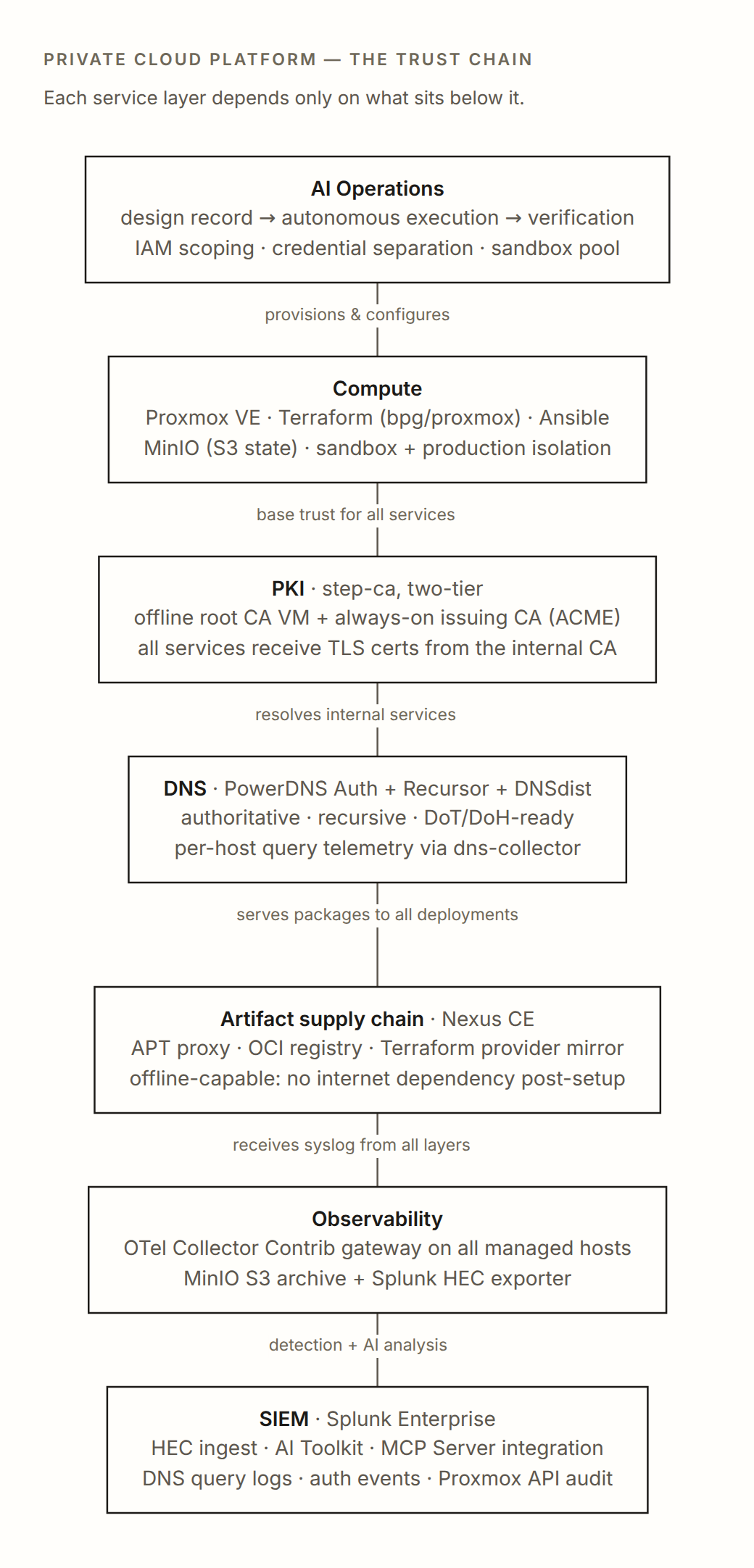
A platform with explicit dependencies
Terraform provisions the compute layer, while Ansible configures services through reusable roles. MinIO provides S3-compatible remote state. Above that foundation, an offline root CA and an online step-ca issuing CA provide internal certificates through ACME.
The DNS layer combines PowerDNS Authoritative, Recursor, and DNSdist. Nexus provides an APT proxy, an OCI registry, and a Terraform provider mirror, allowing managed hosts to use internal artifact sources after bootstrap. An OpenTelemetry Collector gateway receives fleet telemetry and routes it to a MinIO archive and Splunk Enterprise. Splunk brings DNS, authentication, and infrastructure events together for investigation and downstream projects.
These dependencies affect deployment order. Certificate trust has to exist before a host can reliably fetch packages over internal TLS, and the artifact service cannot be treated as available while it is still being bootstrapped. Per-service feature flags support phased deployment instead of requiring every change to rebuild the entire platform.
Network boundaries beneath the automation
The workloads sit on a network foundation configured separately from the Terraform and Ansible layer. Management and infrastructure services, application services, the main LAN, and the deployment sandbox occupy distinct zones.
The important boundary is the access policy between zones, not the existence of VLANs. The documented service-zone policy permits selected DNS and certificate-service access; the management zone uses a default-deny allowlist. Administrative access follows a different trust path from ordinary service traffic. The sandbox provides a place to rehearse destructive deployment work without treating production as a disposable test environment.
The network documentation records unresolved policy issues alongside the intended design. The platform automation depends on this foundation, so service deployment and network policy need to be understood together.
Design choices that constrain operations
Sandbox and production credentials are separated, and infrastructure permissions are scoped to the resources an operation needs. The root CA remains offline while the issuing CA handles routine certificate requests. Artifact access is centralized rather than giving every managed host unrestricted dependency-fetching responsibilities.
The AI operations layer is also part of the threat model. Its network access, infrastructure credentials, and tool use are constrained, with planning, generation, and evaluation separated by review gates. These controls add setup and review work, but keep an agent’s proposed action distinct from its authority to execute it.
Testing a rebuild from cold
The deployment path had failures that were not visible in an already-running environment. I used a repeated destroy-and-rebuild campaign against the sandbox to expose bootstrap assumptions, then added behavioral verification after deployment. A service reporting “active” was not enough: checks needed to establish that it could perform its intended function.
One recurring failure involved package management. Cloud-init and Ansible could compete over first-boot upgrades and package locks. Additional timing adjustments did not resolve the underlying ownership problem. The final change waited for cloud-init to finish and moved the day-one package upgrade under Ansible’s control, making the sequence explicit.
In the final recorded run, the full cold rebuild succeeded on its first attempt. Idempotency reruns reported no changes on every managed host. A negative test deliberately stopped DNSdist: the verification gate failed, then returned to green after service restoration. That tested the checker as well as the deployment.
These results establish a working rebuild path for the tested sandbox configuration.
Making telemetry useful end to end
The original DNS telemetry path deployed without delivering data. Investigation found a signal-type mismatch—the upstream output emitted traces while the collector expected logs—and an input-path limitation in the upstream integration.
The pipeline was redesigned around RFC 5424 syslog over TCP, with changes carried into the Ansible roles and configuration generator. The recorded sandbox verification accepted 142 DNS records with zero failures. Authentication-log forwarding was also deployed across seven hosts. These were delivery checks, not throughput benchmarks.
Operating and documenting the platform
Design records and runbooks preserve dependencies, deployment decisions, and known debts. The accompanying internal documentation distinguishes verified facts from assumptions and unresolved questions so that a later operator can tell what still needs checking.
The platform remains a maintained system rather than a frozen demonstration. Its public repository exposes the implementation without publishing private network identifiers; the internal documentation is not linked publicly.